
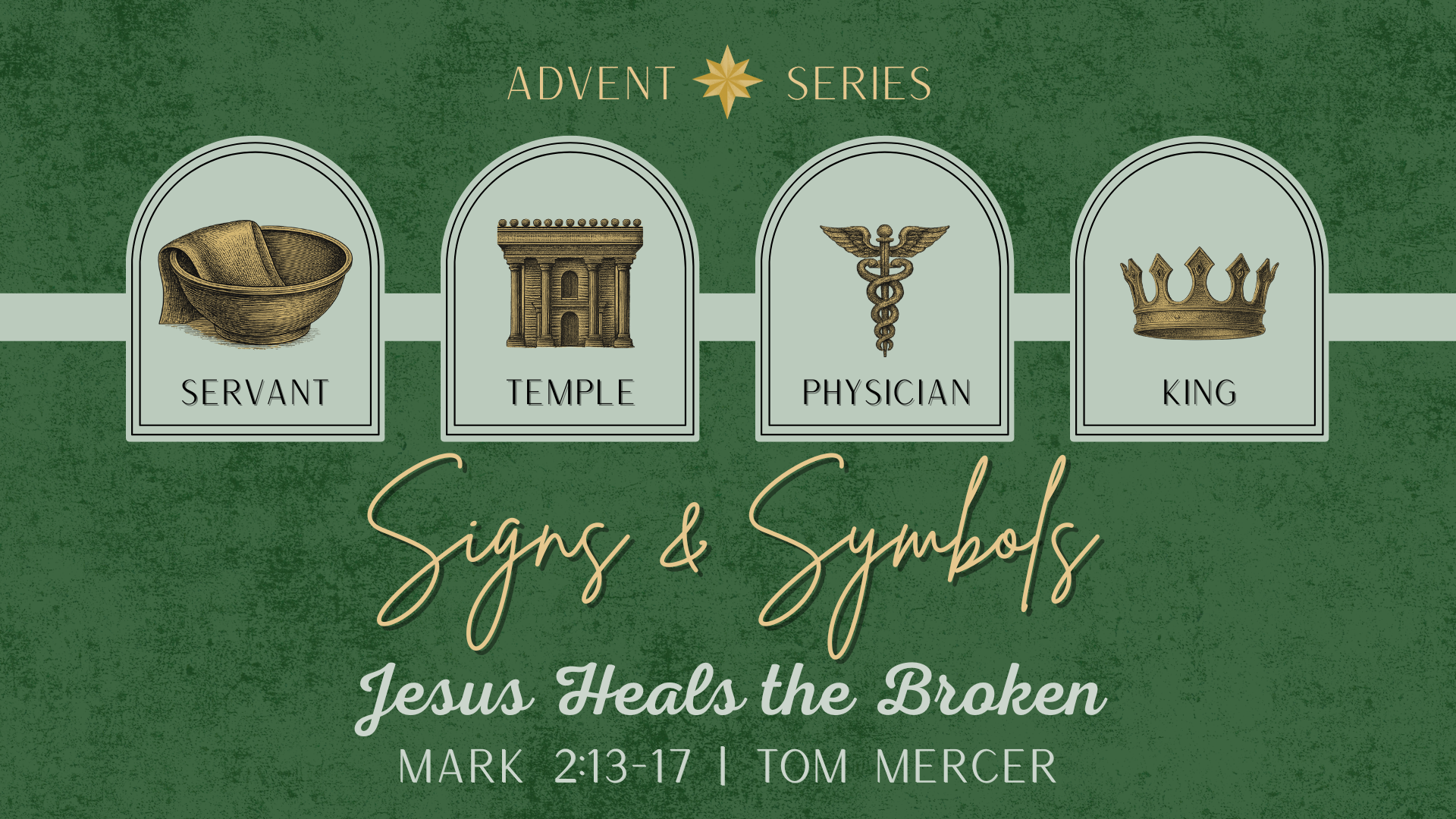
Prepare for Sunday morning worship by using the guide below.
Mark 2:13-17
13 He went out again beside the sea, and all the crowd was coming to him, and he was teaching them. 14 And as he passed by, he saw Levi the son of Alphaeus sitting at the tax booth, and he said to him, “Follow me.” And he rose and followed him.
15 And as he reclined at table in his house, many tax collectors and sinners were reclining with Jesus and his disciples, for there were many who followed him. 16 And the scribes of the Pharisees, when they saw that he was eating with sinners and tax collectors, said to his disciples, “Why does he eat with tax collectors and sinners?” 17 And when Jesus heard it, he said to them, “Those who are well have no need of a physician, but those who are sick. I came not to call the righteous, but sinners.”
Watch the Sermon

Summary: As we continue our Advent series, this week we are looking at Mark 2:13–17, where Jesus compares His ministry to the work of a physician. After a physical healing that stirred no small controversy, Jesus re-enters Capernaum and calls Matthew (Levi) the tax collector to be His disciple. Jesus’ invitation to a greedy traitor of Israel ruffles the feathers of many, including the religious leaders. When Jesus continues His ministry through a dinner celebration at Matthew’s house, the Pharisees question His methods. They ask His disciples why Jesus has such intimate friendships with known sinners. Jesus responds by comparing Himself to a doctor: a physician is only helpful to the sick, and those who follow Him must recognize their sin-sickness. We rejoice that Jesus has come for sinners, because we are all in desperate need of His healing ministry.
Review & Apply
What is the main reason for believing that the Levi in verse 14 is the apostle Matthew we see in other gospels?
What is the significance of Jesus "reclining" with known sinners? How does this account inform our relationships and ministry?
Was Jesus just informing the Pharisees that His goal was to call people to repentance, or is there a subtle challenge/rebuke in his statement?
Are we quick to categorize people in our lives as "righteous" or "sinners"? How does this story challenge that type of judgment?
When you consider your own righteousness, do you believe Jesus added a little bit onto a pretty good life or do you consider yourself bankrupt apart from Him? How might this passage help you recognize Christ's righteousness and your sinfulness?
As we consider Advent (A.K.A. coming), are you encouraged that Jesus "came" for sinners? How does this statement draw us to our Savior?
Give
If you would like to give online CLICK HERE. For all things come from you, and of your own have we given you. (1 Chronicles 29:10-18)